School groups pursue compromise on budget reserves
Credit: California Senate Democrats
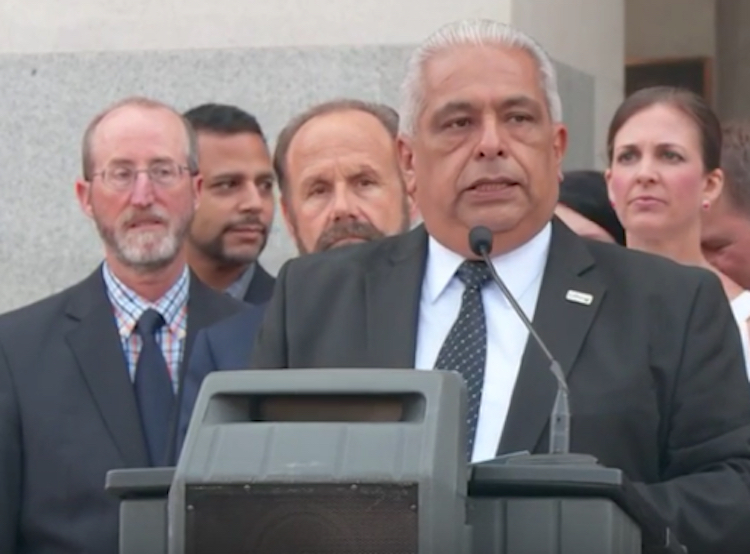
California School Boards Association President Jesús Holguín explains SB 799 at an Aug. 18 press conference in Sacramento. Behind him are the chief authors, Sen. Steve Glazer, D-Orinda (left), and Jerry Colina, D-San Mateo (behind Holguín), forth with co-author Assemblywoman Kristin OIsen, minority leader in the Associates.
 Credit: California Senate Democrats
California School Boards Clan President Jesús Holguín explains SB 799 at an Aug. eighteen press conference in Sacramento. Behind him are the primary authors, Sen. Steve Glazer, D-Orinda (left), and Jerry Loma, D-San Mateo (behind Holguín), along with co-writer Assemblywoman Kristin OIsen, minority leader in the Assembly.
A year-long battle betwixt a coalition of school organizations and the California Teachers Association over commune reserves has taken a new turn.
The dispute is over how much districts should exist allowed to continue in reserve equally a result of new limits that were set last year. The reserve cap became police force after the CTA persuaded legislative leaders and Gov. Jerry Brown to insert the change into cleanup linguistic communication as function of terminal year'due south land budget negotiations.
The CTA had complained that districts were hoarding a bonanza of mail-recession funding that information technology argued should be spent on student programs and services. Groups including the California Schoolhouse Boards Association, Association of California Schoolhouse Administrators, the California Association of School Business Officers, the California State PTA and the League of Women Voters countered that the new reserve cap was fiscally irresponsible, even though information technology likely is years away from taking event. They claim it is a ploy to strength more money saved for emergencies onto the bargaining table for potential pay raises and benefits.
Only having failed to persuade the Legislature to repeal the cap, the groups, led by the school boards clan, have proposed a belatedly-session compromise to loosen the restrictions and fully exempt the state'south smallest districts.
Senate Neb 799, which the schoolhouse boards association wrote, would raise the limit on a district's unrestricted budget reserve to 17 percentage of its full general fund, in those years when a reserves cap is imposed. That's nearly triple the 6 percent reserve under current law for almost large and moderately sized districts. The new limit would not utilise to money that districts have prepare aside for specific purposes.
The exemption would remove the cap entirely for districts with fewer than 2,501 students and the x pct of holding-wealthy districts, known as "bones aid" districts, that are funded primarily through local belongings taxes, non state revenues. Together, small and basic aid districts comprise near two-thirds of all districts, according to the school boards association.
"We believe this beak is a good compromise and a solution that both houses of the Legislature and the governor can support," said Dennis Meyers, assistant executive director, governmental relations, for the schoolhouse boards association.
In a video argument, Molly McGee Hewitt, executive director of the concern officers association, said, "We believe repeal is non a political reality even though (the cap) is not audio public policy. This is a take a chance to modify and change the reserve cap and to give back for our school districts some stability that we have lost."
Even if the cap won't be triggered for several years, the schoolhouse boards association and other groups desire it changed now. They view it as an intrusion on the principle of local control.
The school boards association fabricated repealing the cap its top legislative priority for the yr. But in May, Democrats who formed the majority in the Assembly Education Commission defeated repeal legislation sponsored by Assemblywoman Catharine Bakery, R-Danville. Republican Sen. Jean Fuller, R-Bakersfield, withdrew her version of the bill from the Senate Pedagogy Committee.
Prospects for SB 799, with less than 2 weeks before the Legislature adjourns for the twelvemonth, remain uncertain. Ii Senate Democrats, Jerry Hill, D-San Mateo, and freshman Steve Glazer, D-Orinda, are the prime authors, with 15 Republican and Democratic legislators every bit co-authors. But the bill is stuck for now in the Assembly Rules Committee, which could send it either to the Assembly Education Committee for review or directly to the Assembly flooring for a vote.
A spokesperson for the CTA said, without elaborating, that the union opposes the beak.
Districts currently have no limit on the size of their reserves, which are funds left over at the end of a twelvemonth. They tin employ the reserve every bit a stockpile for emergencies and downturns in state acquirement or as a set-bated for future purchases, such as technology or building repairs.
Democrats supporting the current police force, led by Assemblyman Patrick O'Donnell, a former instructor who chairs the Assembly Educational activity Committee, said that the school boards association and others are exaggerating the risks of the budget cap.
Nether electric current law, the cap on district reserves would become into result merely in a year after the state puts any money into a special rainy day fund for K-12 schools and community colleges. Those years, tied to tight revenue requirements under Proposition 98 and other conditions, would be rare – and probably not in the next 3 years at the primeval, the Legislative Analyst's Function predicted in May. Districts could use to county offices of teaching for an exemption.

Credit: Legislative Annotator'southward Role
Districts essentially increased their reserves as a protection from budget cuts after the recession. The size of the reserves varied widely, with the smallest districts building the largest reserves. The median reserve for large districts – those with more than thirty,000 students – was nether 20 percent in 2013-14. The proposed limit for SB 799 would be 17 percent for money not designated for specific purposes.
Depending on a district's size, the cap would range from iii percent of a district's full general budget for the state'southward largest district, Los Angeles Unified, to 10 percent for the smallest districts, with 6 percent the boilerplate for moderately sized districts.
Even if the cap won't be triggered for several years, the school boards association and other groups want it changed at present. They view it as an intrusion on the principle of local command that Gov. Brown espoused and the Legislature adopted with the Local Control Funding Formula. And they said the depression cap could jeopardize their fiscal stability in an economic downturn, make it harder to manage their cash and cause bond rating agencies like Moody's and Standard and Poor'south to lower districts' credit ratings, raising the toll of borrowing money.
An LAO assay earlier this twelvemonth of 2013-xiv found that, had the cap been in effect and so, less than 10 percentage of the state's districts would have met the reserve requirements. Districts had $7.iii billion in unrestricted reserves, while the police would accept fix a limit of $2.viii billion.
Democrats: Potential harm is overstated
Democrats supporting the current law, led by Assemblyman Patrick O'Donnell, a quondam teacher who chairs the Associates Education Committee, said that the school boards association and others are exaggerating the risks. The law already permits schoolhouse boards to vote to shift money for specific future uses into what'southward chosen a "committed reserve" that doesn't count toward the cap. And that's what districts would do to bring the unrestricted reserves down if the cap went into effect, they predict.
Only Meyers called this option an unnecessary work-around, calculation complexity to a bad police force. SB 799 instead would require schoolhouse boards to present annually an explanation of what's in the reserves and justify the uses – a better grade of transparency, he said.
Hill and the school boards clan chose 17 pct every bit the limit because that'due south the amount that the Government Finance Officers Association, a national organization, recommends that local districts keep in reserve, with more than money in times of volatile revenue. That corporeality equals between two and three months of a commune's operating expenses, said LAO analyst Kenneth Kapphahn, who wrote the LAO analysis. The LAO institute that the median reserve for big districts with the strongest bond ratings was 17 percent.
Sen. Bob Huff, R-Diamond Bar, who stepped down this week equally Senate minority leader, said that Republicans favor repeal of the cap, which he called a "dumb" policy, but would back up SB 799 as written. Nevertheless, noting that the finance officers recommended 17 per centum as a minimum reserve, not as a limit, he said he was concerned that the number would exist whittled down in negotiations over the nib.
Gov. Brown has not indicated whether he would support revising the reserves cap that he agreed to insert in the budget language a year agone.
To become more reports like this one, click here to sign upward for EdSource's no-cost daily email on latest developments in education.
Source: https://edsource.org/2015/school-groups-pursue-compromise-on-budget-reserves-and-budget-cap/86035
0 Response to "School groups pursue compromise on budget reserves"
Post a Comment